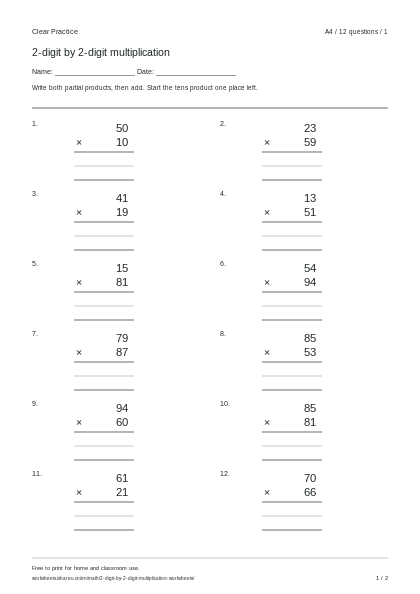
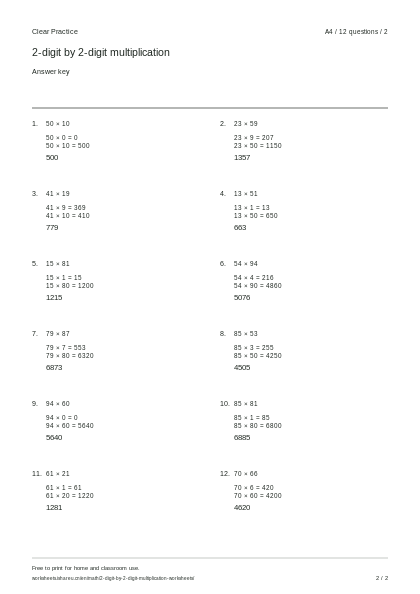
2-digit by 2-digit multiplication
12 column problems, with space for both partial products.
Download PDF with answersMake more like this: 2-digit by 2-digit multiplication worksheets →Preview answer key
 Open full-size PDF
Build written-calculation fluency, then add fractions, remainders, geometry, and unit conversion one topic at a time.
Free to use · no sign-up · print or save as PDF · separate answer key
Grade labels are a planning guide; follow the sequence used by your school and adjust for the learner.
Choose multiplication for partial products, fractions for equal parts and simplification, or geometry for area and perimeter. Match the sheet to the skill being taught.
Each A4 PDF has two pages: questions first, then answers. Print at 100% size. Use the worksheet maker to change the question count or paper size.
12 column problems, with space for both partial products.
Download PDF with answersMake more like this: 2-digit by 2-digit multiplication worksheets →Open full-size PDF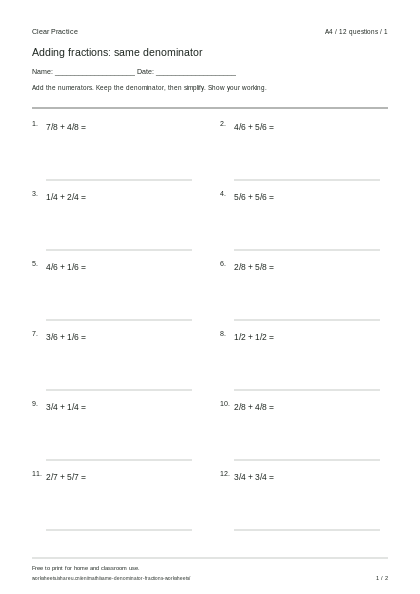
12 additions with denominators from 2 to 8. Worked answers show how to simplify; some sums exceed 1.
Download PDF with answersMake more like this: Same-denominator fraction addition worksheets →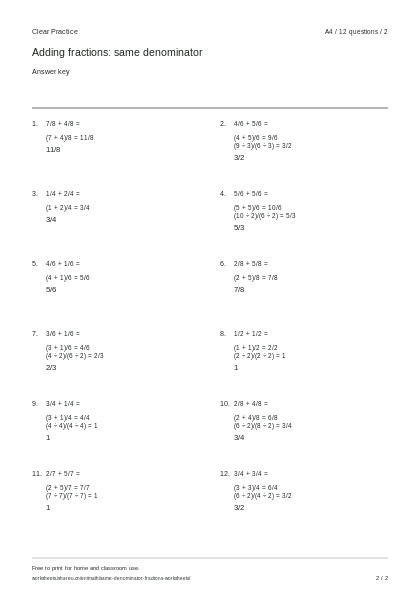 Open full-size PDF
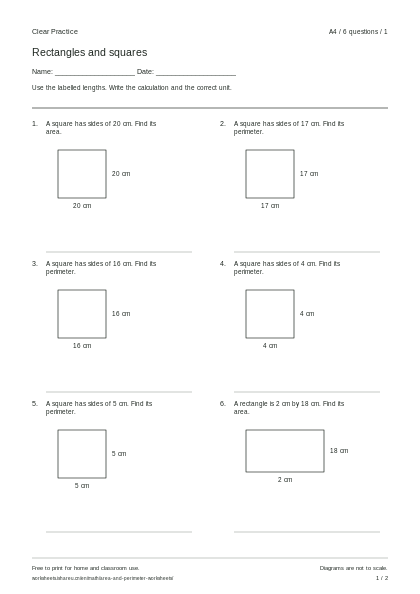
6 area or perimeter questions, with labelled diagrams.
Download PDF with answersMake more like this: Area and perimeter worksheets →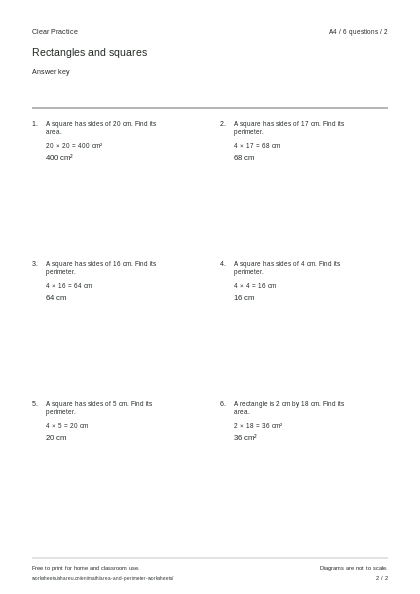 Open full-size PDF
Open a focused set, adjust the question count or difficulty, then print the worksheet and answer key.
Write the ones and tens partial products, then add.
Example: 47 × 63 = 2,961Find the quotient and the remainder.
Example: 47 ÷ 6 = 7 r 5Read the sign before each single-operation calculation.
Example: 34 + 18 = 52; 9 × 6 = 54Add proper fractions with the same denominator.
Example: 2/7 + 3/7 = 5/7Use labelled diagrams to find area, perimeter or a missing side.
Example: A rectangle is 8 m by 5 m. Area = 40 m², perimeter = 26 mDownload length or mass sheets, or make a mixed conversion set.
Example: 3.5 m = ____ cm, so 350 cmAdd in columns, keeping ones and tens aligned.
Example: 47 + 36 = 83Subtract in columns and mark borrowed units.
Example: 72 − 38 = 34Use the long-division layout and record any remainder.
Example: 156 ÷ 12 = 13Align decimal points before adding.
Example: 12.45 + 3.7 = 16.15Read the clock and find the time after a given interval.
Example: 45 minutes after 3:30 is 4:15Subtract the price from the amount paid to find the change.
Example: An item costs $13.60; paying $20 gives $6.40 changeFind the equal step between numbers, then fill the gap.
Example: 4 → 7 → ____ → 13; the missing number is 10Classify angles as acute, right or obtuse.
Example: 120° is an obtuse angleChoose two operations to solve each word problem.
Example: There are 12 red and 9 blue balls; 5 are removed. 12 + 9 − 5 = 16Use these explanations when a learner needs to revisit why a method works before completing another sheet.
Use a single-column layout when the method needs several written steps.