Focused practice

Area and perimeter worksheets

Choose area, perimeter or missing-side questions. The diagrams label known lengths, and the answer key shows calculations and units.

Free to use · no sign-up · print or save as PDF · separate answer key

20Questionspreset · print · share

Download a ready-made worksheet

Each A4 PDF has two pages: questions first, then answers. Print at 100% size. Use the worksheet maker to change the question count or paper size.

Start with a focused set

Choose a set to replace the current questions. Paper size, answer visibility and versions stay as selected.

Compare the sets
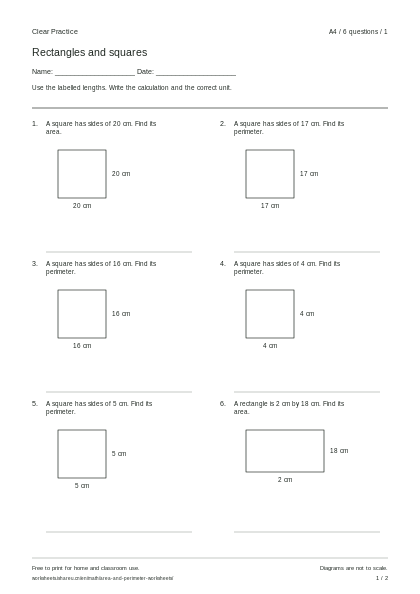
  • Rectangles & squares — 10 area and perimeter questions. No missing sides.
  • Perimeter only — 10 questions on the boundary of rectangles and squares.
  • Area only — 10 questions on the area of rectangles and squares.
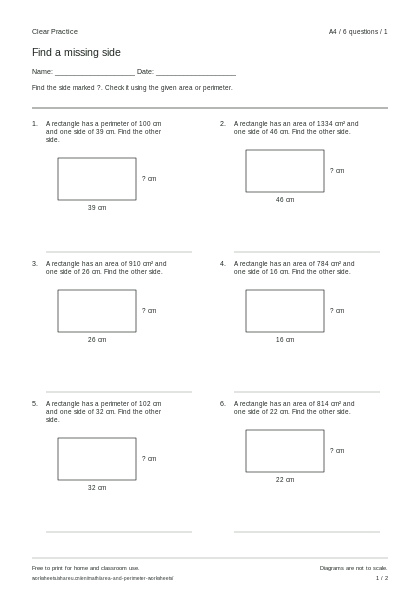
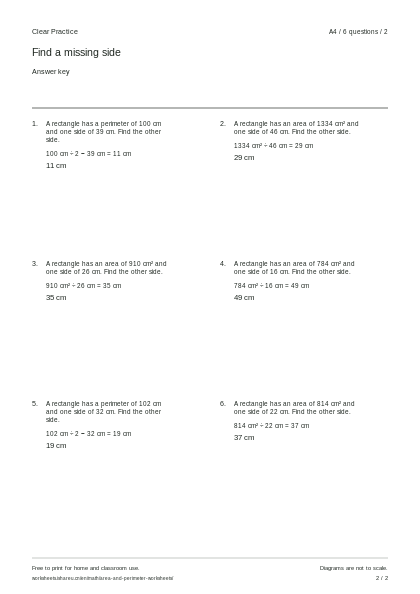
  • Find a missing side — 10 rectangles with a side found from area or perimeter.
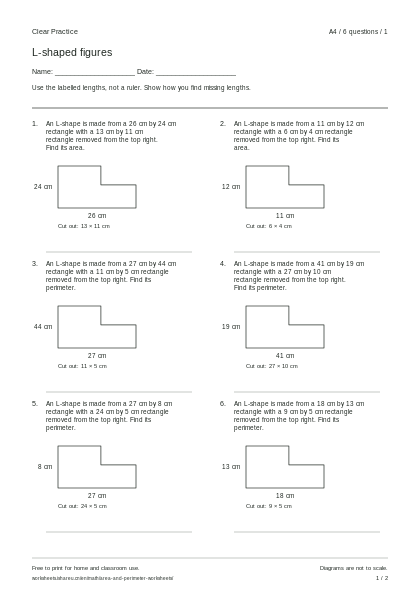
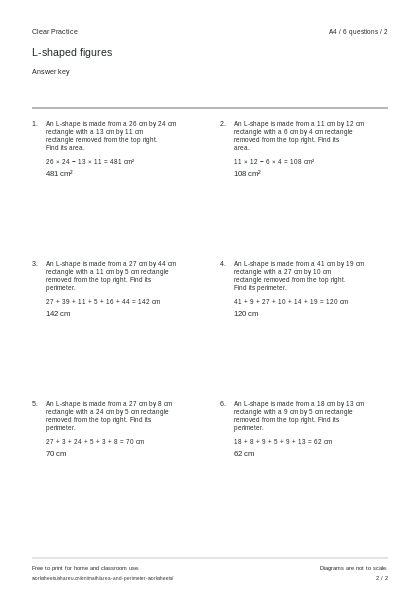
  • Composite L-shapes — 10 area or perimeter questions on L-shaped figures.

Geometry practice
Change shapes, units or focus

Right triangles practise area. Composite L-shapes support area and perimeter.

View worksheet
Title, layout and versions
Mixed worksheet modules

Select one or more modules and set the question count for each. Leave all unchecked to use the page topic.

Advanced arithmetic settings
Operators
Print fields and style

This worksheet is made on your device. We do not ask for student details.

Saved worksheet settings

Save the question type, count and layout for next time. Names, handwriting text and manual edits are not saved. “Recreate questions” restores the original questions before any edits.

    Area and perimeter worksheets
    Name: ____________________Date: ____________________
    1.A square has sides of 28 m. Find its area.
    2.A rectangle has an area of 442 m² and one side of 17 m. Find the other side.
    3.A square has sides of 10 cm. Find its perimeter.
    4.A rectangle is 11 cm by 25 cm. Find its perimeter.
    5.A rectangle has an area of 800 m² and one side of 16 m. Find the other side.
    6.A square has sides of 37 cm. Find its perimeter.
    7.A rectangle is 3 cm by 47 cm. Find its perimeter.
    8.A rectangle is 42 m by 47 m. Find its perimeter.
    9.A square has sides of 34 m. Find its perimeter.
    10.A rectangle is 12 cm by 49 cm. Find its area.
    11.A rectangle is 46 cm by 18 cm. Find its perimeter.
    12.A rectangle is 23 cm by 12 cm. Find its area.
    13.A rectangle is 28 m by 14 m. Find its area.
    14.A square has sides of 20 m. Find its perimeter.
    15.A square has sides of 30 cm. Find its area.
    16.A square has sides of 10 cm. Find its area.
    17.A rectangle is 18 m by 37 m. Find its area.
    18.A square has sides of 31 m. Find its perimeter.
    19.A square has sides of 29 cm. Find its area.
    20.A square has sides of 15 cm. Find its perimeter.
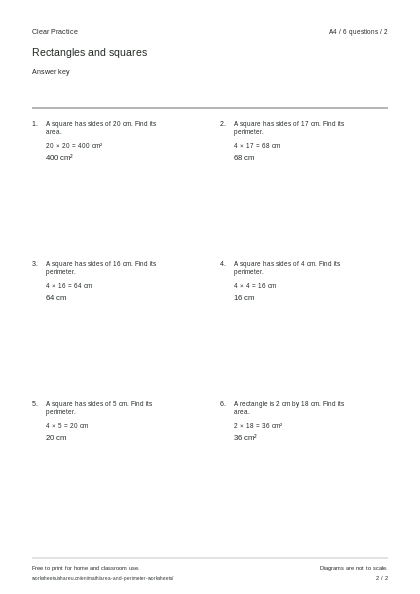
    Answer key
    1. A square has sides of 28 m. Find its area.28 × 28 = 784 m²784 m²
    2. A rectangle has an area of 442 m² and one side of 17 m. Find the other side.442 m² ÷ 17 m = 26 m26 m
    3. A square has sides of 10 cm. Find its perimeter.4 × 10 = 40 cm40 cm
    4. A rectangle is 11 cm by 25 cm. Find its perimeter.2 × (11 + 25) = 72 cm72 cm
    5. A rectangle has an area of 800 m² and one side of 16 m. Find the other side.800 m² ÷ 16 m = 50 m50 m
    6. A square has sides of 37 cm. Find its perimeter.4 × 37 = 148 cm148 cm
    7. A rectangle is 3 cm by 47 cm. Find its perimeter.2 × (3 + 47) = 100 cm100 cm
    8. A rectangle is 42 m by 47 m. Find its perimeter.2 × (42 + 47) = 178 m178 m
    9. A square has sides of 34 m. Find its perimeter.4 × 34 = 136 m136 m
    10. A rectangle is 12 cm by 49 cm. Find its area.12 × 49 = 588 cm²588 cm²
    11. A rectangle is 46 cm by 18 cm. Find its perimeter.2 × (46 + 18) = 128 cm128 cm
    12. A rectangle is 23 cm by 12 cm. Find its area.23 × 12 = 276 cm²276 cm²
    13. A rectangle is 28 m by 14 m. Find its area.28 × 14 = 392 m²392 m²
    14. A square has sides of 20 m. Find its perimeter.4 × 20 = 80 m80 m
    15. A square has sides of 30 cm. Find its area.30 × 30 = 900 cm²900 cm²
    16. A square has sides of 10 cm. Find its area.10 × 10 = 100 cm²100 cm²
    17. A rectangle is 18 m by 37 m. Find its area.18 × 37 = 666 m²666 m²
    18. A square has sides of 31 m. Find its perimeter.4 × 31 = 124 m124 m
    19. A square has sides of 29 cm. Find its area.29 × 29 = 841 cm²841 cm²
    20. A square has sides of 15 cm. Find its perimeter.4 × 15 = 60 cm60 cm
    Advertisement
    Worksheet details

    Diagrams and worked answers

    Every problem includes a labelled diagram. Make a focused sheet for area, perimeter, or missing sides from either measure, then choose rectangles, squares, right triangles, or composite L-shapes. The answer key shows the calculation, not only the result.

    • Labelled diagram with every question
    • L-shape area and perimeter practice
    • Missing-side steps from area or perimeter

    Missing sides and L-shapes: choose the calculation

    One missing side, two starting points

    8 cm?

    The given measure is either an area of 40 cm² or a perimeter of 26 cm. Each calls for a different first step.

    Compare the methods and checks
    1. From area: divide by the known side, 40 ÷ 8 = 5 cm. Check: 8 × 5 = 40 cm².
    2. From perimeter: halve it, then subtract the known side, 26 ÷ 2 − 8 = 5 cm. Check: (8 + 5) × 2 = 26 cm.

    Side lengths use cm; area uses cm². Subtracting 8 from 26 alone leaves three sides, not the missing width.

    L-shaped area: subtract or split

    8 cm6 cm5 cm3 cm2 cm4 cm

    Start with an 8 cm × 6 cm rectangle and remove a 3 cm × 2 cm corner. The remaining lengths are 8 − 3 = 5 cm and 6 − 2 = 4 cm.

    Compare both area methods and the perimeter
    1. Subtract the cut-out: 8 × 6 − 3 × 2 = 42 cm².
    2. Split along the dotted line: 5 × 6 + 3 × 4 = 42 cm².
    3. Add the boundary lengths for the perimeter: 5 + 2 + 3 + 4 + 8 + 6 = 28 cm. Exclude the internal dividing line.
    02

    What this worksheet includes

    • 20 questions by default, with 10 or 30 also available
    • Easy uses rectangles and squares; medium adds missing sides; hard adds right triangles and composite L-shapes
    • Composite L-shapes can be used for area or perimeter practice
    • Missing sides are found from area or perimeter, with worked answers

    Choosing a practice session

    • Grades 3–6 measurement practice
    • Distinguishing perimeter from area
    • Practising correct unit notation

    Content reviewGeneration rules and examples checked 1 November 2026. Found a problem? Send a correction

    03

    Need to change the range?

    The full maker lets you change the range, difficulty, amount of working space, and other print settings.

    Set up a area and perimeter sheet →

    Before or after this skill