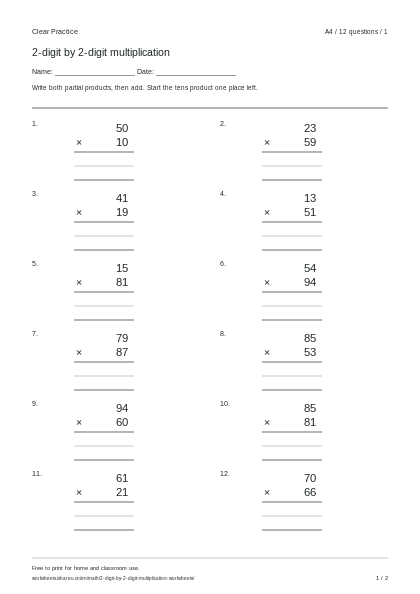
2-digit by 2-digit multiplication
12 column problems, with space for both partial products.
Download PDF with answersMake more like this: 2-digit by 2-digit multiplication worksheets →Preview answer key
 Open full-size PDF
Choose multi-digit calculation, fractions, decimals or measurement. Leave room for estimates and intermediate steps.
Free to use · no sign-up · print or save as PDF · separate answer key
Grade labels are a planning guide; follow the sequence used by your school and adjust for the learner.
For whole-number calculation, choose multiplication or long division. For fractional amounts, choose unlike-denominator addition or decimals. The fraction sheet assumes the learner can find equivalent fractions; the decimal sheet uses up to two decimal places.
Each A4 PDF has two pages: questions first, then answers. Print at 100% size. Use the worksheet maker to change the question count or paper size.
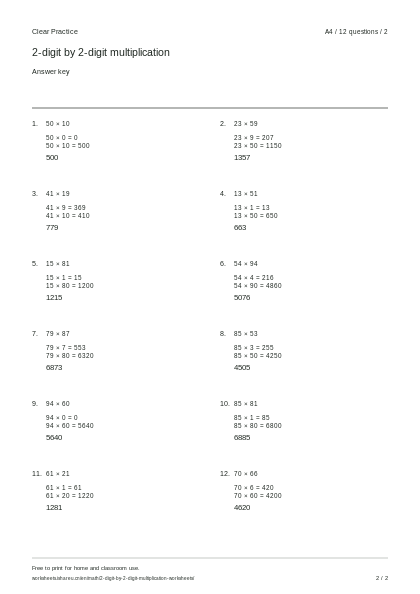
12 column problems, with space for both partial products.
Download PDF with answersMake more like this: 2-digit by 2-digit multiplication worksheets →Open full-size PDF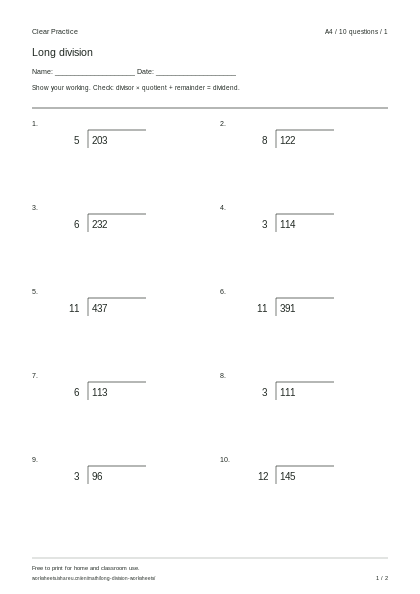
10 division problems, including remainders, with room for working.
Download PDF with answersMake more like this: Long division worksheets →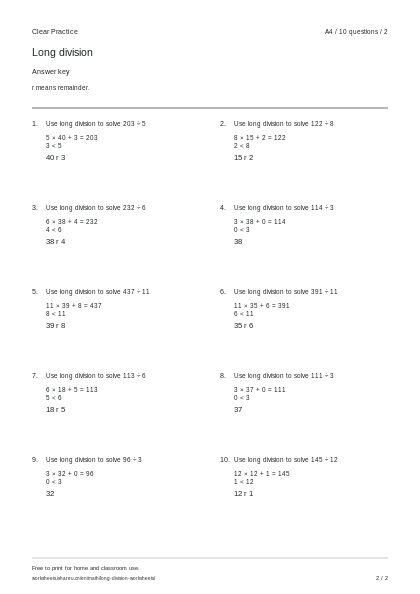 Open full-size PDF
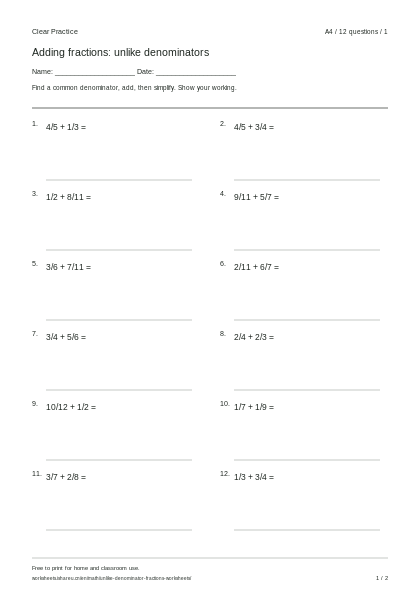
12 fraction additions. Answers are in simplest form.
Download PDF with answersMake more like this: Unlike-denominator fraction addition worksheets →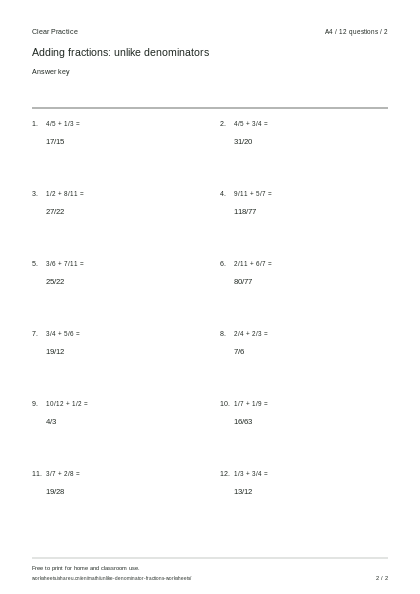 Open full-size PDF
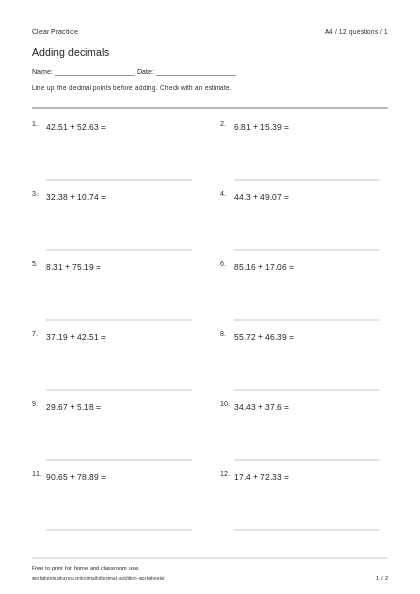
12 additions with up to two decimal places. Align the decimal points.
Download PDF with answersMake more like this: Decimal addition worksheets →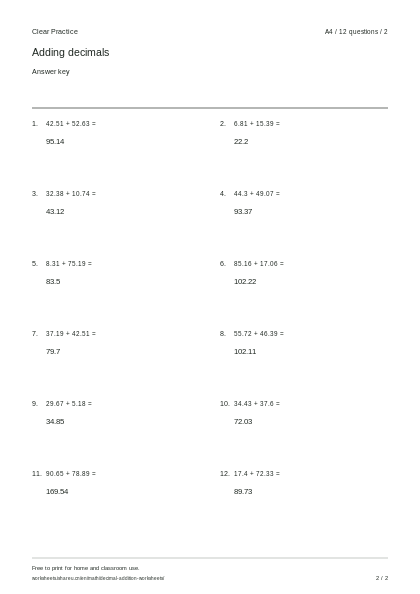 Open full-size PDF
Open a focused set, adjust the question count or difficulty, then print the worksheet and answer key.
Write the ones and tens partial products, then add.
Example: 47 × 63 = 2,961Use the long-division layout and record any remainder.
Example: 156 ÷ 12 = 13Read the sign before each single-operation calculation.
Example: 34 + 18 = 52; 9 × 6 = 54Find a common denominator before adding, then simplify.
Example: 1/3 + 1/4 = 7/12Use labelled diagrams to find area, perimeter or a missing side.
Example: A rectangle is 8 m by 5 m. Area = 40 m², perimeter = 26 mDownload length or mass sheets, or make a mixed conversion set.
Example: 3.5 m = ____ cm, so 350 cmAlign decimal points before adding.
Example: 12.45 + 3.7 = 16.15Find a percentage of a quantity or simplify a ratio.
Example: 25% of 80 = 20Subtract the price from the amount paid to find the change.
Example: An item costs $13.60; paying $20 gives $6.40 changeFind the equal step between numbers, then fill the gap.
Example: 4 → 7 → ____ → 13; the missing number is 10Classify angles as acute, right or obtuse.
Example: 120° is an obtuse angleChoose two operations to solve each word problem.
Example: There are 12 red and 9 blue balls; 5 are removed. 12 + 9 − 5 = 16Use these explanations when a learner needs to revisit why a method works before completing another sheet.
Start with 10 questions on one skill. Review mistakes before choosing a mixed sheet.