For class, tutoring, or a quick practice at home

Same-denominator fraction addition worksheets

Both proper fractions in each question use the same denominator, allowing learners to focus on adding numerators.

Free to use · no sign-up · print or save as PDF · separate answer key

Download a ready-made PDF (12 questions + answers, A4)Preview sheets ↓

20Questionspreset · print · share

Download a ready-made worksheet

Each A4 PDF has two pages: questions first, then answers. Print at 100% size. Use the worksheet maker to change the question count or paper size.

Layout, versions & title
Mixed worksheet modules

Select one or more modules and set the question count for each. Leave all unchecked to use the page topic.

Advanced arithmetic settings
Operators
Print fields and style
View worksheet

This worksheet is made on your device. We do not ask for student details.

Saved worksheet settings

Save the question type, count and layout for next time. Names, handwriting text and manual edits are not saved. “Recreate questions” restores the original questions before any edits.

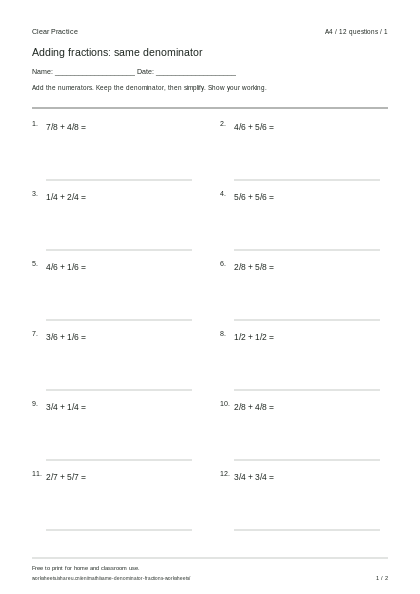
    Same-denominator fraction addition worksheets
    Name: ____________________Date: ____________________
    1.6/8 + 2/8 =
    2.2/4 + 3/4 =
    3.2/3 + 2/3 =
    4.4/6 + 4/6 =
    5.1/5 + 3/5 =
    6.1/3 + 2/3 =
    7.2/3 + 1/3 =
    8.2/6 + 1/6 =
    9.4/5 + 2/5 =
    10.3/5 + 2/5 =
    11.4/5 + 3/5 =
    12.4/7 + 6/7 =
    13.1/6 + 5/6 =
    14.3/8 + 5/8 =
    15.1/2 + 1/2 =
    16.3/7 + 2/7 =
    17.4/7 + 4/7 =
    18.4/7 + 2/7 =
    19.2/4 + 1/4 =
    20.3/8 + 1/8 =
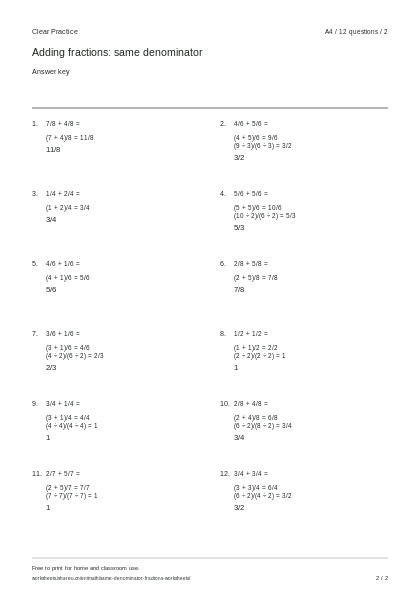
    Answer key
    1. 6/8 + 2/8 =(6 + 2)/8 = 8/8(8 ÷ 8)/(8 ÷ 8) = 11
    2. 2/4 + 3/4 =(2 + 3)/4 = 5/45/4
    3. 2/3 + 2/3 =(2 + 2)/3 = 4/34/3
    4. 4/6 + 4/6 =(4 + 4)/6 = 8/6(8 ÷ 2)/(6 ÷ 2) = 4/34/3
    5. 1/5 + 3/5 =(1 + 3)/5 = 4/54/5
    6. 1/3 + 2/3 =(1 + 2)/3 = 3/3(3 ÷ 3)/(3 ÷ 3) = 11
    7. 2/3 + 1/3 =(2 + 1)/3 = 3/3(3 ÷ 3)/(3 ÷ 3) = 11
    8. 2/6 + 1/6 =(2 + 1)/6 = 3/6(3 ÷ 3)/(6 ÷ 3) = 1/21/2
    9. 4/5 + 2/5 =(4 + 2)/5 = 6/56/5
    10. 3/5 + 2/5 =(3 + 2)/5 = 5/5(5 ÷ 5)/(5 ÷ 5) = 11
    11. 4/5 + 3/5 =(4 + 3)/5 = 7/57/5
    12. 4/7 + 6/7 =(4 + 6)/7 = 10/710/7
    13. 1/6 + 5/6 =(1 + 5)/6 = 6/6(6 ÷ 6)/(6 ÷ 6) = 11
    14. 3/8 + 5/8 =(3 + 5)/8 = 8/8(8 ÷ 8)/(8 ÷ 8) = 11
    15. 1/2 + 1/2 =(1 + 1)/2 = 2/2(2 ÷ 2)/(2 ÷ 2) = 11
    16. 3/7 + 2/7 =(3 + 2)/7 = 5/75/7
    17. 4/7 + 4/7 =(4 + 4)/7 = 8/78/7
    18. 4/7 + 2/7 =(4 + 2)/7 = 6/76/7
    19. 2/4 + 1/4 =(2 + 1)/4 = 3/43/4
    20. 3/8 + 1/8 =(3 + 1)/8 = 4/8(4 ÷ 4)/(8 ÷ 4) = 1/21/2
    Advertisement

    Why does the denominator stay the same?

    1/63/64/6

    Every part is one sixth of the same-sized whole. One part plus three parts makes four parts; their size stays the same.

    1/6 + 3/6 = (1 + 3)/6 = 4/6

    Both 4 and 6 are divisible by 2, so 4/6 = (4 ÷ 2)/(6 ÷ 2) = 2/3.

    Adding the denominators would give 4/12. Check the drawing: each whole still has six equal parts.

    02

    What this worksheet includes

    • 20 questions by default; the ready-made PDF has 12
    • Denominators: 2–8 on easy, 2–12 on medium, 2–20 on hard
    • Both addends are proper fractions with the same denominator; sums can exceed 1
    • Worked answers add the numerators and show any simplification

    Choosing a practice session

    • Introducing fraction addition
    • Practising numerator addition
    • Reviewing equivalent simplified forms

    Content reviewGeneration rules and examples checked 1 November 2026. Found a problem? Send a correction